The Wind Window Is a State Space
Kitesurfing through a control engineer lens: the wind window as a state space, kite position as the real throttle, edges as stable equilibria, and the power zone as a high-gain region where force scales with wind speed squared.
After enough time tuning PID and LQG loops for a drone, you stop being able to look at any dynamic system innocently — including a kite. Kitesurfing gets taught with beach metaphors, clock faces, and shouting. Underneath, it is one of the cleanest control problems you can physically stand inside, and thinking about it that way made the sport click for me faster than any metaphor did.
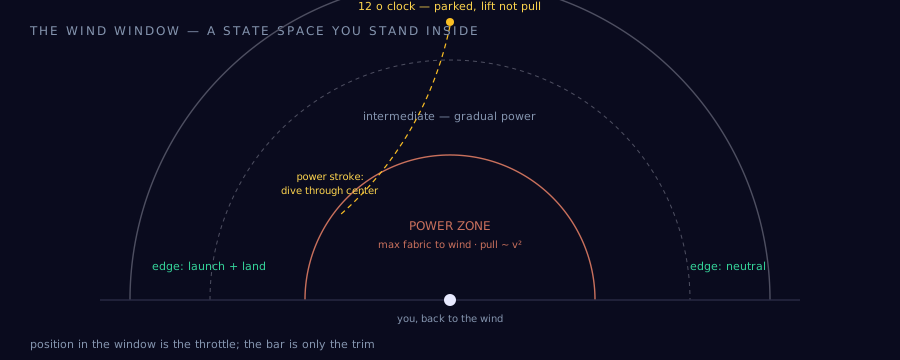
The window is your state space
Stand with your back to the wind and the kite lives on a quarter-sphere in front of you — the wind window. Every position in that window has a force vector attached, and the map is not uniform: at the edges, the kite meets the wind nearly edge-on, shows it almost no fabric, and produces close to zero pull — these are the stable, low-energy states, which is exactly why launching, landing, and every recovery happens there. Straight downwind in the power zone, the kite shows the wind its full area and the force is maximal. In control terms: the window is the state space, and the plant gain varies enormously — and predictably — with position in it.
Position is the throttle, the bar is the trim
The counterintuitive lesson every beginner fights: the bar in your hands is not the throttle. Sheeting in and out changes angle of attack — a trim input, useful but second-order. The dominant input is where the kite is and how fast it is moving through the window. A power stroke — diving the kite from parked-at-twelve down through the center — is deliberately steering the state through the high-gain region to harvest force. Two inputs, wildly different authority: any drone pilot who has mixed a strong control axis with a weak one knows this shape, and knows the failure mode of grabbing the weak input in a panic.
Gain scheduling, by nature
The window geometry never changes, but its gains do: pull in the power zone grows with roughly the square of wind speed. Fifteen knots and thirty knots present the same map with radically different amplitudes — the same kite input that is gentle in the first is violent in the second. That is gain scheduling, imposed by physics: the correct response to more wind is not stronger arms but a smaller kite or a shallower path through the window — reduce plant gain, do not fight it with actuator effort. Every discipline that touches control converges on the same rule, and the sea enforces it more memorably than any simulator.
Why engineers should try it
The feedback loop runs at body rate: state estimation by looking up, actuation through a bar, disturbance rejection in gusts, and consequences measured in salt water rather than log files. It is the rare system where you are the controller — no code between you and the plant. My drone work taught me what the equations look like; the window is where you feel what a high-gain region means. Both kinds of knowing turn out to matter.