Graph Engineering: The Term Is New, the Engineering Is Not
The 2026 "graph engineering" wave has no paper behind it — a loop is already a graph. But the layer above loop engineering is real: typed shared state with merge rules, external-signal verify nodes, searched topologies, and statically checkable workflows.
In June 2026 Addy Osmani gave the agent-building craft its unit of work: loop engineering — do → check → decide, with the discipline living in making the check real. A month later, a tweet kicked off "graph engineering" as the next layer up, and within two weeks a dozen guides declared the paradigm shift.
Here's my honest read after digging through what's underneath: the term is marketing; the layer is real. No paper uses it, no framework adopted it, and the sharpest critique lands cleanly — a loop is already a graph; it's just a graph whose path returns to an earlier node. But strip the branding away and there really is an engineering discipline above the single loop. It just already has published research, and none of it needed the new name.
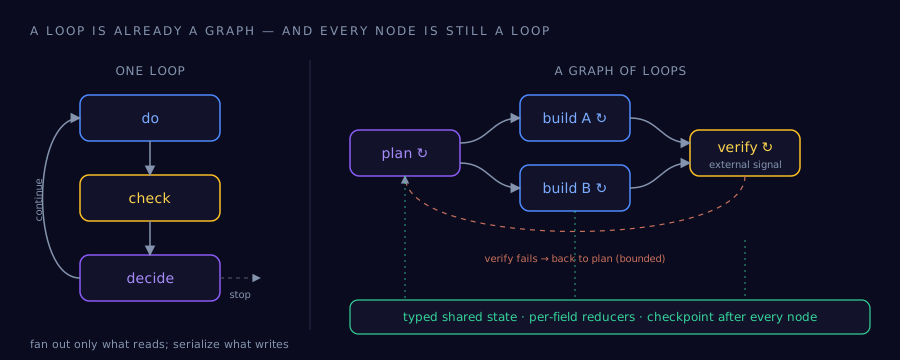
Every node is still a loop
The wrong mental model is "graphs replace loops." The right one: a graph is wiring between loops. Each node keeps its own do/check/decide cycle; the graph decides what flows between them, what runs in parallel, and where the whole thing is allowed to cycle back. If one loop solves your problem, one loop is the better system — the graph is what you reach for when a single context can't hold the work.
The state is the contract
The most useful mechanism in the whole space is the one the hype barely mentions: typed shared state with per-field merge rules. Not a chat transcript passed around — a schema, where every field declares how concurrent writes combine, and a checkpointer persists after every node so a run can resume or rewind.
from typing import Annotated, TypedDict
import operator

class RunState(TypedDict):
    goal: str                                      # last write wins
    artifacts: Annotated[list[str], operator.add]  # concurrent writes accumulate
    verdict: str                                   # written only by verify

g = StateGraph(RunState)
g.add_node("plan", plan_loop)
g.add_node("build_a", build_loop)   # read-heavy: safe to fan out
g.add_node("build_b", build_loop)
g.add_node("verify", verify_loop)   # graded by test execution, not by itself
g.add_edge("plan", "build_a")
g.add_edge("plan", "build_b")
g.add_edge("build_a", "verify")
g.add_edge("build_b", "verify")
g.add_conditional_edges("verify", route_verdict)  # fail -> plan, bounded
app = g.compile(checkpointer=saver)  # resume + time-travel per node
Two rules make this graph honest. First, the fan-out rule: read-heavy work parallelizes; write-heavy, tightly-coupled work does not — and agents that share only summaries instead of full traces fragment context and diverge. Second, the verify node uses an external signal. The peer-reviewed record on intrinsic self-correction is brutal: without grounding (tests, tool output, a separate reward model), asking the loop to grade itself makes accuracy drop.
Topology is a search space, not a taste
The strongest argument that this layer is real engineering: hand-designed graphs are already being beaten by searched ones. MCTS over workflow topologies reaches frontier-model quality at a few percent of the cost; agentic-supernet approaches sample a bespoke topology per query; and at scale, irregular topologies beat the tidy meshes and trees humans draw — with returns saturating around a hundred agents. If topology can be optimized against a benchmark, it was never a matter of style.
Graphs are checkable — so check them
The quiet superpower of writing the orchestration down as a graph: static analysis works on it. One recent checker run across public agent-workflow benchmarks found structural violations in about a quarter of graphs and policy violations in over half. And the largest multi-agent failure study puts unaware of termination among the top failure modes — a property you can check on a graph before a single token is spent. Nobody reviews their agent topology the way they review code. That, not the vocabulary, is the actual gap.
The counter-evidence keeps the layer honest
The 2026 research that best supports taking graphs seriously is, usefully, the research pushing back on them. A pointed line of work shows that a strong single-agent baseline — one loop, good tools, honest checks — rivals or beats many published multi-agent workflows, which means a graph must earn its wiring against that baseline, not against a strawman. And the search-based work keeps moving past static design: test-time co-evolution adjusts topology and agent capability together per task, and precompute-and-reuse systems cache solved workflow shapes and retrieve them for similar queries instead of re-searching. The pattern across all of it: topology is treated as an optimizable, reusable artifact — measured, cached, versioned — which is precisely what distinguishes an engineering layer from a diagramming habit.
What to take home
Skip the term. Steal the mechanics: write the state schema before the prompts, let concurrent fields declare their merge rule, fan out reads and serialize writes, gate every cycle-back edge with an externally-graded check and a bound, checkpoint per node — and then lint the graph like the program it is.